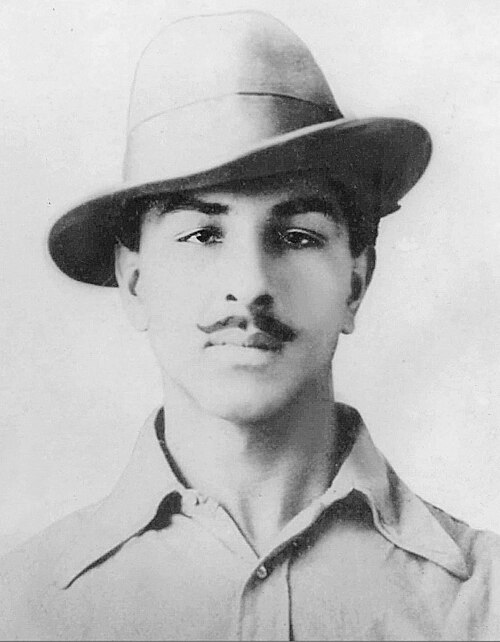
As I am 34 now, wandering about what to do in life, daily my goals changes, daily my philosophy changes, daily I have a constant battle between my conscience and my thoughts, to be honest I am just a aged man without belief but recently while watching protests in my country the name Bhagat Singh come in limelight and it amazes me that still after 100 years of his death nobody even as a joke says something bad about him.
It bothers my conscience that when this generation don’t even know what to do in their prime peak life, how could a 23-year-old guy decided to die for his country
How does a 23-year-old develop that kind of conviction?
They found out the bigger purpose in life
When Bhagat Singh was in his twenties, he was already spent lot of time reading, learning and debating and participating in freedom movement. He has a fair conscience by that time that not to react emotionally under the British rule.
His belief of getting independence or Poorna swaraj was not simply just replace British ruler with Indian ruler instead he wanted to make a society that is built around equality in social justice and meant good for all.
At his age if a person thought like this or finds Questions to these type of answers, personal comfort doesn’t mean anything to one’s life.
VISIONARY
It is easy to say that Bhagat Singh was a young man and a revolutionary leader who wants to die for his country but we are missing one important part of his thinking that he did not worship death, understood that death is the consequence for his belief and his ideologies.
He really wants to Awaken people.
While watching movie the legend of bhagat singh, in scene after the central legislative bombing in 1929, Bhagat Singh and Batukeshwar dutt, they deliberately stayed at the assembly and let themselves to be arrested. The bombs thrown was a different political protest rather that an attempt to cause mass casualities.
That message was more important than the explosion.
He understands the power of symbolism. He was a young revolutionary standing in trial, speaking fearlessly in court and refuse to apologies for his acts, this symbol could reach to millions of people than the underground pamplets .
He famously expressed the idea that individuals could be killed, but ideas could not be destroyed. That belief gave his death a meaning beyond himself.
Preparation was his confidence
He read extensively. He engaged with Marxist thought, revolutionary literature, philosophy, history and political theory. His prison writings reveal a young man constantly questioning himself and the world around him. This is important because confidence is often mistaken for certainty.
Real confidence can come from having spent years thinking about what you believe.
Bhagat Singh knew he was going to die but then also his writing in jail shows no signs of stress or fear of death, he was not looking for an answer, he already made his choice.
His confidence came from convictions on his beleief that his life is temporary rather than his ideas to give a spark among millions of people about his ideologies. He was not thinking about the next day he was thinking to make history.
What About Young People Today?
Today’s 25-year-olds might have greater access to opportunities, knowledge, and education than Bhagat Singh could have ever dreamed of. However, a lot of young people still find it difficult to respond to a simple question:
“What do I truly want to live for?
However, it would be too simple to blame the current generation.
The generation of Bhagat Singh could see an adversary. Colonial rule by the British was an actual thing. The injustice was immediate, obvious, and political.
The issues of today are different. Economic uncertainty, career pressure, social media comparison, information overload, loneliness, and a persistent need to seem successful are all challenges that young people must deal with.
There isn’t just one revolution to join or one enemy to battle.
Confusion may be the outcome.
We have more choices than ever, but sometimes too many choices make it harder to choose anything at all.
The Real Lesson of Bhagat Singh
The lesson of Bhagat Singh is not that every 23-year-old should be willing to die for a cause.
The more crucial lesson is that purpose is not inherently created by age. Thought, research, experience, and dedication are the building blocks of purpose. The fact that Bhagat Singh was prepared to give his life did not make him exceptional. He was remarkable because he had spent his brief existence posing challenging questions and then acted in accordance with the conclusions he came to.
Perhaps that is what today’s generation can learn from him.
More young people who are willing to die are not what we need. More young individuals who are prepared to live for something greater than themselves are needed.
To construct something, to make anything better, to get up when it’s uncomfortable, to assist those who are unable to pay you back, to engage in in-depth study rather than just information consumption, to have values so solid that they are difficult to alter due to convenience.
Bhagat Singh did not have everything figured out at the age of 23. In actuality, his works show a person who was aware of his beliefs but was still thinking, learning, and asking questions.
And maybe that’s the true distinction.
Why today’s youth lack the bravery of Bhagat Singh is not the question.
The question is much more personal – At 23, 25 or 30, what do we believe strongly enough to devote our lives to? Bhagat Singh found his answer the challenge for every generation is to find its own.