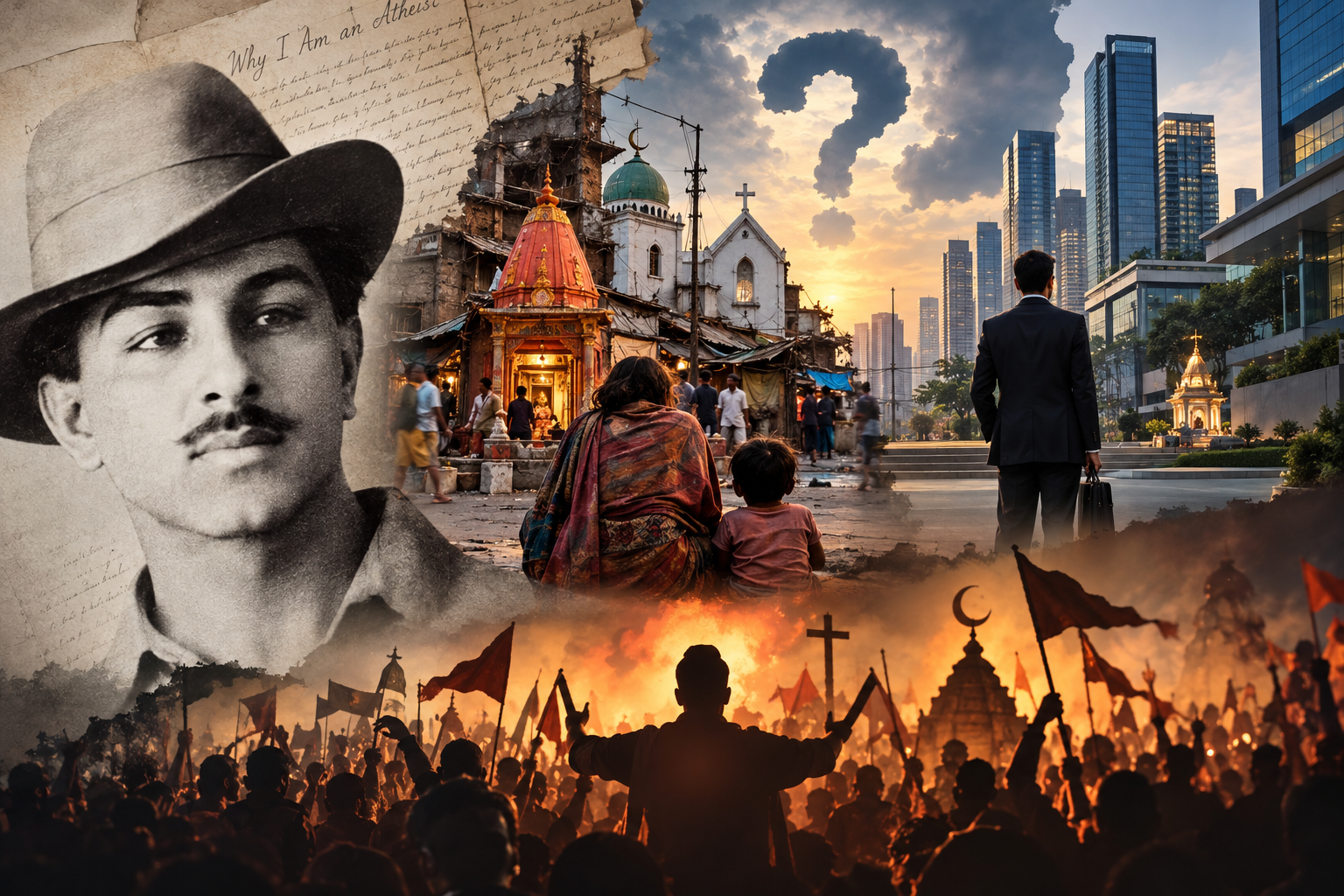
I was listening to one of my friends conversation, he was telling me that in Bhagat Singh’s essay “Why I Am an Atheist,” there is a line which states that “mein isliye nastik nahi ki mjhe dharam se nafrat hai, mein isliye nastik hun ki dharam ko insaniyat se nafrat hai” and somehow this line has stuck in my head till date. what I understood, his hatred of religion did not make him an atheist. Because the religion he observed around him didn’t seem to care about people, he became an atheist. I couldn’t get that idea out of my head, and when I looked around, I didn’t like what I saw.
Everyone today seems to have appointed themselves the guardian of religion. Nobody asked them to, but they’re ready to explain what God wants, what’s allowed and what isn’t. And somehow God’s wishes always match their own convenience. What suits them is “faith.” What doesn’t suit them is “against our religion.” People have become so self-serving that they bend even God to fit their needs. This isn’t about one community either. Whichever religion you pick, the same thing is happening.
Another thing I’ve observed is that folks who are impoverished and have little awareness of their environment tend to be quite religious, whereas those who go on to study, travel, and lead comfortable lives are frequently the first to stray from it. I am aware that it is not a rule. I’ve encountered both highly educated individuals who are very religious and ignorant individuals who don’t give a damn. However, it’s difficult to overlook if you look at the overall pattern.
Just look at where we build our places of worship. Walk into a poor neighbourhood and you’ll find a temple, a mosque, a church, sometimes all within a few steps of each other. Now go to a fancy new township or a big corporate area where the educated and the well-off work. You’ll hardly find one, or it’ll be tucked away in a corner somewhere.
Why is that? I think the answer is fairly simple. A poor person wants a better life, and often they have no way of getting it on their own. So they hand their hopes, their fears and their unfinished dreams to God, because there’s nobody else to hand them to. A rich person already has most of what they wanted, so God doesn’t come up very often. That makes me wonder whose fault this is. Is it man’s or is it the fault of whoever made man this way, if there is such a being? If He exists, why make us like this?
Then there’s the way we use God to cover our failures. “It wasn’t in my destiny.” “It was God’s will.” These lines are so comforting. I’ve said them myself. When you fail, it feels much better to blame fate than to sit down and ask what you did wrong. I’m not saying everyone who believes is lazy. But if every defeat gets handed over to destiny, we never learn anything from it, and nothing changes.
Here’s another thing that fascinates me. Take a hardcore atheist, someone who has argued for years that God is a story people invented. Now let a sudden disaster hit his life, a serious accident or the loss of someone he loves. In that moment, the first words out of his mouth are very often “Oh God.” Is that hypocrisy? Maybe. Or maybe it’s just what fear does to us, because when we’re terrified, we don’t think logically, we grab whatever is closest. So who’s to blame, religion or the man? I honestly don’t know. But I do think a belief, or a disbelief, that only holds up on good days isn’t worth much.
Now think about history. People have killed each other in the name of religion for as long as we have records, and not just in one place or one period. I think the reason is that religion is the fastest way to bring a crowd together. Give people one flag, one slogan and one enemy, and you’ve got an army. But whoever can gather a crowd can also steer it. The powerful have understood this for centuries. They saw our fears, our insecurity and our dread of losing the people we love, and they used all of it for their own gain. And the thing you’re not allowed to question is the easiest thing to rule with.
That’s why Bhagat Singh’s thinking still hits hard. I don’t think his main question was whether God exists. I think he was asking whether we’re willing to use our own minds. He was asking whether our faith brings people closer or pushes them apart.
Here’s where I’ve landed, for now. Religion by itself is neither a weapon nor a shield. It becomes whatever the person holding it wants it to be. In some hands it’s a lamp that brings comfort, service and kindness. In others it’s a torch that burns down a neighborhood. You can’t really blame the torch. But I keep coming back to the same uncomfortable question. If someone made us, why did He make us so ready to turn a lamp into a torch?
I don’t think anyone has a solution, and I don’t either. I do know that whether you believe or not, the test ought to be the same. Does what you think make it easier for someone who is hungry to eat? Does it give courage to someone who is afraid? Does it cause you to show respect to others who are different from you? It makes no difference what name your religion goes by if the response to all three is negative. It has failed in the one crucial area. Thus, let compassion be public and religion remain private.