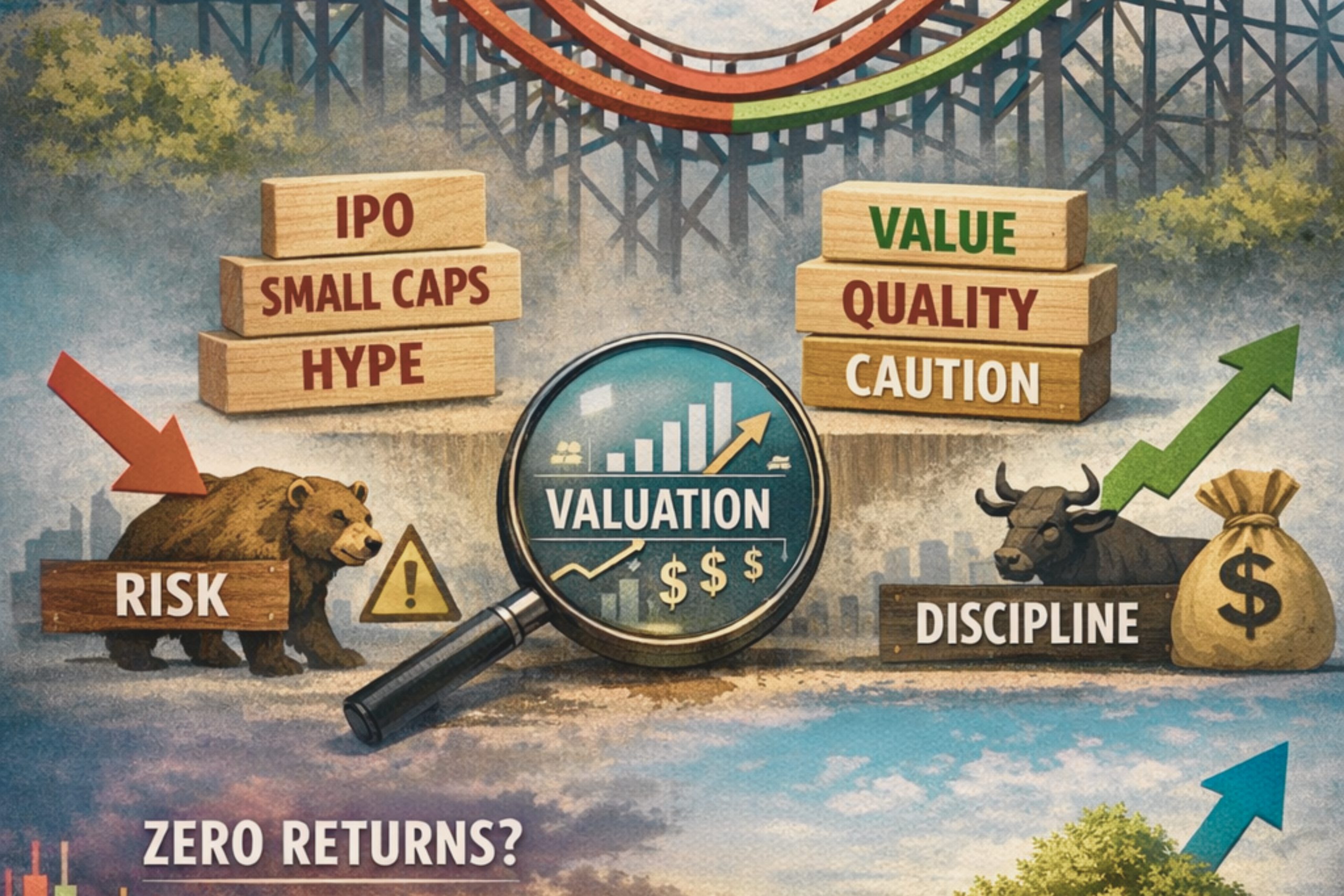
One of the most dangerous assumptions in investing is believing that markets are designed to reward you quickly and consistently. When investors experience a strong bull run early in their journey, they often internalize the idea that equity markets are permanent wealth machines. But markets don’t operate on our expectations. They operate on cycles.
There have been periods in Indian market history where returns were extraordinary and rapid. There have also been long stretches where returns were flat, frustrating, and emotionally exhausting. The difference between successful long-term investors and disappointed ones is not intelligence-it is understanding cycles.
A market being overvalued does not automatically mean it will crash. Expensive assets can remain expensive for a long time. Think of premium real estate in places like Lutyens’ Delhi or Malabar Hill. These locations are always considered expensive, yet they don’t necessarily collapse in price simply because valuations look stretched. Markets function similarly. Overvaluation increases risk, but it does not create a mandatory fall.
The real issue is not whether a correction will happen tomorrow. The real issue is what kind of returns you should realistically expect from current levels.
The Conditions Required to Make “Mega Money”
Investors love the idea of multibaggers and life-changing returns. But historically, mega returns only emerge under specific conditions. To make extraordinary money in equities, two ingredients are usually present: extremely cheap valuations and extreme fear.
When fear dominates headlines and valuations are deeply depressed, that is when long-term wealth is created. Periods like 2002, the 2008 global financial crisis, and the 2020 pandemic crash offered those rare combinations. Investors who had the courage to buy when uncertainty was overwhelming were rewarded disproportionately.
Today, however, the environment is different. Valuations in many segments are slightly above average rather than deeply discounted. Fear exists, but it is mild-not panic-driven. Under such circumstances, expecting mega returns is unrealistic. Moderate long-term returns are far more likely.
This is not pessimism. It is alignment with market history.
The Forgotten Reality: Markets Can Give Zero Returns
Many investors who entered markets after 2020 experienced strong gains quickly. That experience can create the illusion that markets always deliver double-digit returns. History strongly disagrees.
There was a long stretch between the mid-1990s and early 2000s where Indian markets gave almost no meaningful returns. Even in the United States, the NASDAQ Composite delivered virtually zero returns between 2000 and 2012 after the dot-com bubble burst.
Markets move in cycles of excess optimism followed by digestion phases. After a period of very high returns, there is often a phase of consolidation where earnings catch up to prices. That phase can feel disappointing, but it is normal.
If you believe markets must always give mega returns, you are likely to take excessive risks at the wrong time.
The QLC Framework: What to Do as Bull Markets Mature
As bull markets age, investors tend to become more aggressive instead of more disciplined. This is precisely when discipline matters most.
A practical framework for late-stage bull markets is QLC:
Quality. Liquidity. Capitalization.
Quality means owning businesses with stronger balance sheets and governance standards. Liquidity means owning stocks that can be exited easily during volatility. Capitalization means gradually moving toward larger companies rather than chasing smaller, riskier ones.
Ironically, during mature bull markets many investors do the opposite. They reduce quality by buying weaker businesses. They reduce liquidity by investing in unlisted or thinly traded stocks. They reduce capitalization by chasing microcaps and small caps because they appear to offer faster gains.
History suggests that when markets are euphoric, improving QLC is a defensive strategy. Conversely, at market bottoms, the strategy reverses. That is when buying microcaps, illiquid stocks, and even weaker companies can produce extraordinary returns. In 2002, buying the weakest company in a depressed metal cycle would have generated more returns than buying the strongest one, simply because the recovery impact was more dramatic.
Timing within the cycle matters more than simply labeling something as “quality” or “growth.”
Concentration Versus the Zoo Portfolio
Many retail investors unknowingly create what can be described as a zoo portfolio. It contains too many stocks, bought from tips, social media conversations, or scattered research. When you own 25 or 30 stocks without deep conviction, you are not managing a portfolio. You are collecting animals.
If the goal is to outperform meaningfully, concentration becomes important. That does not mean recklessness. It means taking meaningful positions in a few well-researched ideas.
Even legendary investors like Warren Buffett ran highly concentrated portfolios in the early years of their careers. Over-diversification often guarantees average results. In some cases, it can even produce below-market returns due to lack of conviction and weak monitoring.
Position sizing forces seriousness. If you allocate a meaningful portion of capital to one idea, you will naturally do better research and monitoring.
The Art of Selling: The Skill No One Teaches
Buying gets all the attention. Selling is rarely discussed with equal seriousness.
The purpose of investing is to make money-not to hold stocks indefinitely for emotional comfort. There are times when markets become overheated, valuations stretch significantly, and greed dominates conversations. During those phases, protecting capital becomes more important than chasing incremental gains.
Historically, investors who sold during euphoric phases and re-entered during fearful periods multiplied wealth dramatically. Yet most individuals forget the concept of selling because they become attached to rising prices.
Knowing when to exit requires emotional control. It often feels uncomfortable because it involves stepping away from popular enthusiasm. But disciplined selling is a key pillar of long-term compounding.
Asset Allocation as a Contrarian Tool
Asset allocation is often misunderstood as simply spreading money across different categories. In reality, effective asset allocation is a contrarian discipline.
It involves allocating more capital to asset classes that are currently unloved, undervalued, or ignored. A few years ago, gold was out of favor and delivered exceptional returns afterward. Today, gold is near historic highs, which demands greater caution.
Similarly, when US markets or the US dollar dominate global returns for extended periods, future returns often moderate. Rebalancing away from recently strong assets and toward weaker ones may feel uncomfortable, but it aligns with long-term return optimization.
Asset allocation works best when it resists recent performance trends rather than chasing them.
Active Versus Passive in Emerging Markets
Low-cost index funds and ETFs are powerful wealth-building tools. However, in emerging markets like India, active management can still play a meaningful role.
Corporate governance standards fluctuate. Business cycles are sharp. Leverage risks can destroy equity quickly. Active managers sometimes add value by avoiding companies with hidden balance sheet problems or weak governance.
The collapse of institutions such as Yes Bank highlighted how governance risks can damage investors. Active management, when executed responsibly, can reduce exposure to such blow-ups.
In developed markets with strong transparency, passive strategies may dominate. In emerging markets, selective active management still has relevance.
Contrarian Investing With Calculation
Being contrarian is often romanticized. In reality, it is dangerous without discipline.
As investor Seth Klarman famously suggested, you must be contrarian with a calculator. Blind contrarian investing-buying something simply because it has fallen-can lead to permanent capital loss, especially in highly leveraged businesses.
During the 2020 pandemic, simple logical thinking guided successful contrarian bets. Work-from-home required telecom connectivity and stable power supply. These sectors were available at depressed valuations. The logic was straightforward and grounded in necessity, not blind optimism.
Contrarian investing works when supported by balance sheet strength, valuation logic, and survival probability.
IPOs and the Problem of Information Asymmetry
Initial public offerings generate excitement, especially during bull markets. However, IPOs carry a structural imbalance. The seller typically has more information about the company than the buyer.
This asymmetry demands caution. Not all IPOs are bad investments, but entering them purely due to hype can be risky. Evaluating management quality, business sustainability, and valuation multiples becomes essential.
Historically, IPO activity peaks near market highs. That does not mean every IPO will fail, but it increases the probability that valuations are aggressive.
Discipline matters more than enthusiasm.
Journaling: A Simple but Powerful Discipline
One practical tool for retail investors is maintaining an investment journal. Before buying any stock, write down the reason for purchase. Document valuation assumptions, growth expectations, and exit conditions.
Reviewing this journal during volatile periods provides clarity. It prevents emotional decisions and reinforces accountability.
The best time to review your portfolio is not during a crash. It is during stability, when decisions can be made calmly and rationally.
Resetting Return Expectations
Perhaps the most important takeaway is the need to reset expectations. Markets offer a mix of high-return years, moderate-return years, flat periods, and negative phases. All four are part of the investing journey.
The 2020–2024 period delivered unusually strong returns. That does not establish a permanent baseline. If investors assume that every future year will resemble that period, disappointment is inevitable.
A mature investor understands that compounding works over decades, not quarters. Moderate returns sustained consistently often create more durable wealth than erratic bursts of high performance.
Conclusion: The Real Goal Is Survival and Compounding
Investing is not about predicting next month’s index movement. It is about surviving cycles, preserving capital during excess, and deploying aggressively during fear.
You will not always get mega opportunities. But when they appear-deep fear combined with cheap valuations-you must act decisively. During euphoric phases, you must protect capital and improve portfolio quality.
Improve quality, liquidity, and capitalization when optimism is high. Concentrate thoughtfully instead of building a zoo. Be contrarian with calculation. Maintain a journal. Respect cycles.
Above all, remember that the objective is not excitement. The objective is disciplined, long-term compounding.
Markets do not owe us returns. But with patience, rationality, and cycle awareness, they can reward us more than we imagine-just not always when we expect it.