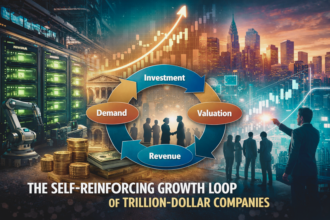
Growth has become the most desirable outcome for every modern business. However, while most teams obsess over acquiring more customers, very few truly understand what sustainable growth really means. Growth is not simply about expanding user numbers or raising top-line metrics. True growth emerges from the intersection of acquisition, retention, and monetization working as one system. When these three components reinforce each other, businesses stop leaking revenue, improve customer lifetime value, and build competitive advantages that compound over time.
This article breaks down the new playbook for achieving sustainable growth in today’s product-driven economy, why monetization sits at the center of the growth system, and how companies can combine both product-led and sales-led strategies to maximize long-term outcomes.
Why Monetization Has Become a Core Driver of Growth
Many businesses still perceive monetization as a purely financial outcome – a way to hit quarterly revenue targets, satisfy a forecast, or justify investor expectations. But monetization is not an afterthought. It is a strategic layer that determines how value is exchanged between the business and customer.
In the traditional model, monetization used to sit in its own silo under sales or finance. Growth teams focused on acquisition. Product teams focused on usage and retention. Sales teams focused on closing deals. The problem is simple: when these functions operate independently, the business generates short-term revenue but sacrifices long-term defensibility.
The modern model treats monetization as an inseparable part of the growth engine. Revenue is no longer a standalone financial metric – it becomes the outcome of activating, retaining, and monetizing users in a deliberate sequence.
The Three Pillars of the Growth Engine
In the simplest form, sustainable growth is driven by three interconnected pillars:
1. Acquisition (Getting Users In)
Acquisition refers to how people discover, sign up, and begin using the product. It could be through:
• organic search
• referrals
• social distribution
• sales outreach
• paid advertising
• partnerships
The most powerful growth models rely on loops rather than funnels. Funnels push users toward a finish line. Loops create systems where every new user drives new inputs back into the system – such as inviting teammates, producing content, or generating usage that attracts others.
2. Retention (Keeping Users Active)
Retention is the most critical indicator of product value. If a business can acquire users but cannot retain them, it has a leaking bucket. Growth without retention is not growth; it is simply expensive acquisition.
Retention forms through:
• fast value realization (“aha moment”)
• habit formation
• consistent usage frequency
• product-market fit
Companies with strong retention spend far less on marketing because users return naturally and often generate word-of-mouth growth.
3. Monetization (Converting Value Into Revenue)
Monetization influences the sustainability of the business. It answers a simple but essential question:
How do we convert user value into revenue without killing adoption or retention?
When monetization is misaligned with product value, friction increases. When it is aligned, customers happily pay because the perceived value outweighs the cost.
Monetization as Friction in the Growth Journey
From a customer perspective, monetization introduces friction. Asking a customer to pay is a moment of tension because value must be proven, not assumed.
A useful model to understand this is:
Price must always be lower than perceived value + friction
Most businesses only optimize price, ignoring friction. Friction includes:
• how predictable the cost is
• when the charge occurs
• how familiar the metric is
• how complex the offering seems
The earlier monetization intercepts the user journey, the higher the friction. The later it occurs, the higher the perceived value, making conversion more likely.
The Timing of Monetization Matters for Growth
Users travel through a predictable adoption journey:
• Acquisition
• Setup
• First Value (Aha Moment)
• Habit Loop
• Core Usage
The timing of the paywall determines how effectively users convert.
Trials
Trials offer full access for a limited period. They are optimized for conversion but limit usage-driven growth. When the trial ends, the user either pays or leaves – there is no middle ground. This approach maximizes direct monetization but ignores the indirect growth benefits of free usage such as virality, network effects, or content production.
Freemium
Freemium allows users to continue using the product for free and become contributors to the growth loop. Many free users may never pay directly, but they create indirect value through:
• referrals
• collaboration
• organic distribution
• product exposure
Freemium typically converts at a lower percentage, but it produces a larger top-of-funnel and reduces marketing spend dramatically.
The Reverse Trial
The most modern approach combines both. Users start with premium access (trial), and after it ends, they drop into a free plan (freemium). This solves two problems:
1. Free users get exposure to paid features
2. Habits form around higher-value usage
As a result, reverse trials significantly increase free-to-paid conversion while keeping loops active.
Choosing Who to Monetize for Growth
Not every user needs to generate direct revenue to drive growth. To understand who should be monetized, businesses must think in terms of use cases, not personas or industries. Each use case is defined by:
1. customer problem (in customer language)
2. alternatives the customer already uses
3. reasons they would switch
4. frequency of usage
5. pain relieved or time saved
High-frequency, high-value use cases produce the strongest monetization potential because they form habits and deliver measurable outcomes.
Pricing Metrics and Their Relationship to Growth
Pricing models determine how revenue scales as usage scales. There are three major categories:
1. Feature-Based Pricing
Customers pay for access to features. It is familiar and easy to predict, but it does not align revenue with customer outcomes. It also creates a hidden risk: customers may pay but never use the product – becoming “sleeping bears.” When re-awakened, these customers often churn instantly.
2. Usage-Based Pricing
Pricing aligns to consumption. Common metrics include:
• seats or users
• compute units
• events
• boards
• messages
• minutes
Usage-based models align the business with customer value and reduce friction at the beginning of the journey. They also reduce the likelihood of dormant paying customers because revenue follows active engagement.
3. Outcome-Based Pricing
This model charges based on the final result, such as:
• transactions completed
• revenue generated
• costs saved
It is the strongest alignment to customer value but the least predictable, making it suitable only for well-understood markets.
Selling Motions and Their Impact on Growth
There are three primary ways to convert users into revenue:
Product-Led Monetization
The product drives self-serve revenue from end users. It works best for lower-tier pricing and low friction experiences. CAC is low, but deal sizes are capped.
Sales-Led Monetization
Sales teams close deals with executives or centralized buying committees. CAC is high, but deal values are significantly larger. This model works in complex, high-stakes environments.
Product-Led Sales (The Hybrid Model)
The modern approach blends both. Users adopt the product first, usage qualifies accounts, and sales teams convert high-intent opportunities. This creates a healthier pipeline and lowers risk in enterprise motions.
Growth Comes From System Thinking, Not Tactics
The key shift in modern strategies is moving from tactical optimization to systemic thinking. Instead of asking:
“How do we acquire more users?”
Businesses now ask:
“How does acquisition feed retention, and how does retention feed monetization?”
When these loops reinforce each other, growth compounds. When they conflict, growth stalls.
The New Rulebook for Sustainable Growth
To summarize the new growth model:
✔ Growth and monetization must be designed together
✔ Not all revenue is good revenue
✔ Monetization timing affects retention
✔ Usage metrics reduce friction and align incentives
✔ Free users can be growth assets, not liabilities
✔ Reverse trials outperform traditional trials
✔ Outcome alignment builds long-term defensibility
✔ Product-led sales unlocks larger enterprise value
The companies achieving the strongest growth today do not optimize for one metric – they optimize for the system. Growth emerges when the customer wins, the product becomes a habit, and monetization feels natural rather than forced.
Final Thoughts
In an era where distribution channels are saturated, advertising costs are rising, and customer expectations are increasing, growth can no longer rely on brute force acquisition. Sustainable growth comes from aligning how users find value, stick with the product, and ultimately exchange money for that value. When acquisition, retention, and monetization synchronize, the business builds momentum that competitors cannot easily replicate