
A few years ago, I spent a week inside a manufacturing cluster in Punjab for a supply chain resilience project. My client was a mid-sized industrial conglomerate trying to understand why their tier-two vendors kept outperforming expectations – absorbing shocks, meeting deadlines, staying solvent – despite operating with a fraction of the resources my client had. The assignment started as due diligence. It ended up changing how I think about business strategy altogether.
I’ve since returned to that question dozens of times while working with companies across South Asia, Southeast Asia, and Europe. And the more I dig, the more convinced I become of something uncomfortable: India’s micro, small, and medium enterprises – the MSMEs everyone mentions in policy speeches but few people actually study – have quietly built one of the world’s most sophisticated management philosophies. They’ve just never written it down.
The strategy most MBAs are taught to ignore
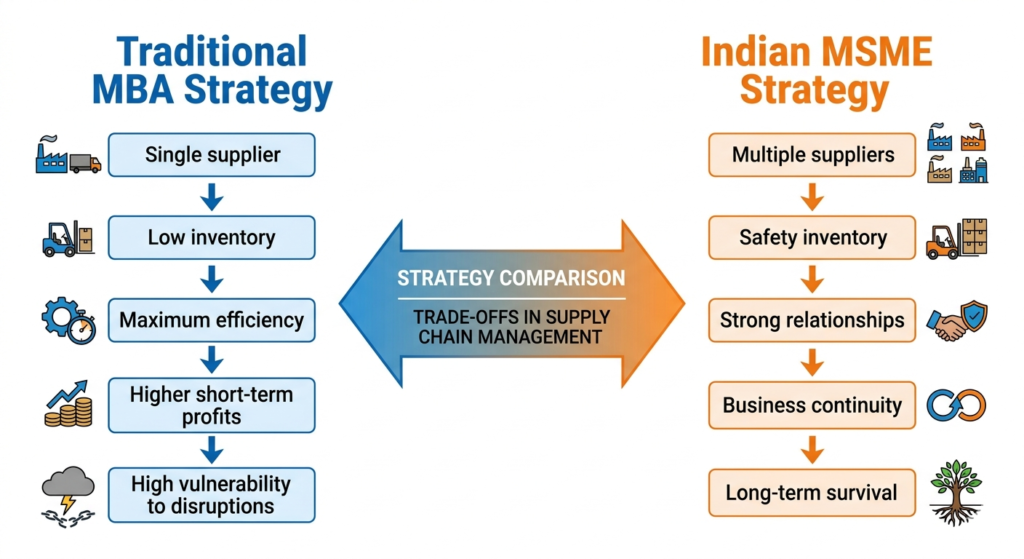
Business schools teach optimization. Reduce inventory. Consolidate suppliers. Maximize asset utilization. These are not bad principles – in stable, predictable environments, they genuinely work. The problem is that most of the world doesn’t operate in stable, predictable environments. And yet the frameworks keep assuming it does.
Walk into a small auto-components factory in Rajkot or a textile unit in Surat and you’ll find business owners making decisions that look, on paper, completely irrational. They maintain three or four supplier relationships when one would suffice. They hold more inventory than just-in-time principles would ever sanction. They extend credit to buyers without a formal contract in sight. A freshly minted MBA would circle these in red and call them inefficiencies.
They are not inefficiencies. They are deliberate choices – shaped by years of operating in environments where the next disruption is never far away. What looks like waste from the outside is actually insurance. What looks like informality is actually a governance system. These businesses are not failing to apply modern management. They’ve decided, after decades of real-world testing, that modern management doesn’t always fit their reality.
That distinction matters enormously – and it’s one that business literature almost entirely ignores.
Reputation as a Balance sheet item
Here’s something I’ve never seen on a standard financial model: the economic value of being known as someone who keeps their word.
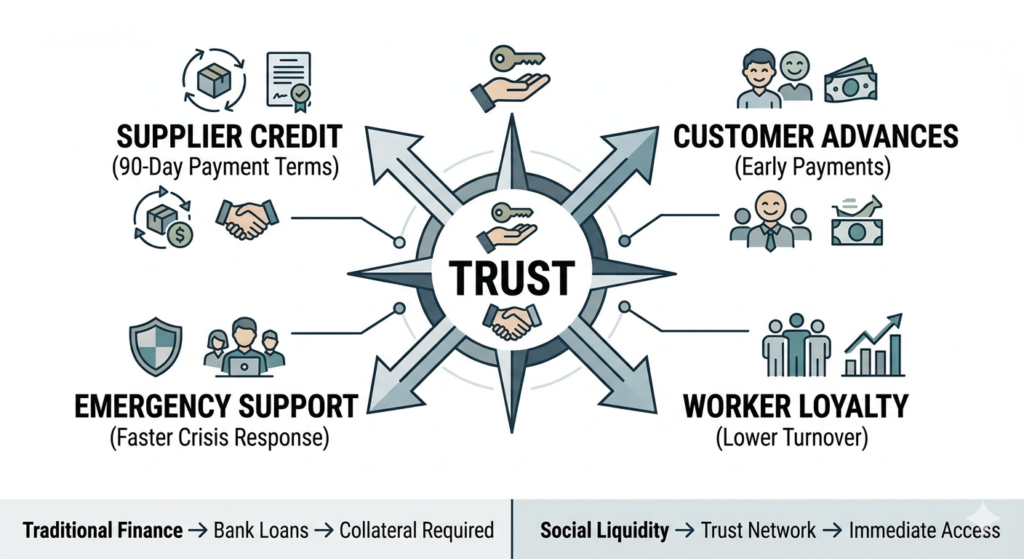
In the ecosystems I’ve studied, trust is not a soft concept. It’s a functional resource – one that determines whether you get raw material on credit during a cash-flow crunch, whether a transporter prioritizes your delivery when trucks are scarce, whether a key worker stays on during a slow month. A business owner who has spent fifteen years consistently honouring commitments – even small ones, even when it’s inconvenient – has built something that no bank statement captures but that directly determines their survival capacity.
Think about what this actually means from a financial perspective. When a supplier extends you 90-day credit because they trust you, you’ve effectively secured working capital without touching a bank. When a long-term customer advances payment because they know you’ll deliver, you’ve solved a liquidity problem that would otherwise require a loan. The formal financial system would take weeks and demand collateral. The trust network does it over a phone call.
I’ve started calling this “social liquidity” – and I genuinely believe it belongs on every risk assessment I write. In markets where formal institutions are slow, expensive, or inaccessible, the businesses with the deepest trust networks are structurally more resilient than businesses with better credit ratings but thinner relationships. Investors rarely price this in. They should.
The knowledge system hiding in plain sight
One of the things that struck me hardest during my Ludhiana visit was how rapidly information moved through the cluster – without any formal mechanism to move it.
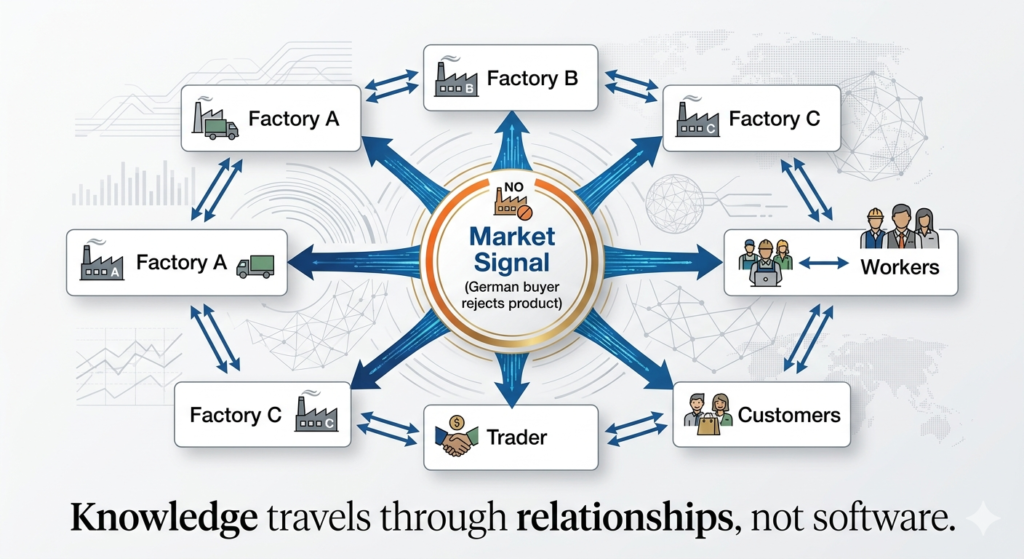
A buyer in Germany had begun rejecting bicycle frames with a specific weld profile. Within two weeks, a dozen manufacturers in the cluster had quietly adjusted their process – not because of any industry circular or formal notification, but because workers had talked, suppliers had flagged it, and a visiting trader had mentioned it to three people who mentioned it to six more. The knowledge had distributed itself.
This is not anecdotal. It is a structural feature of how industrial clusters actually function – and it is wildly under-theorized in the management literature. Companies spend millions building internal knowledge management systems: intranets, CRMs, BI dashboards, post-mortems. Yet here is a geographic concentration of small businesses – many without formal R&D, many without HR departments – that collectively learns faster than many large organizations I’ve advised.
The insight worth sitting with is this: competitive advantage is typically framed as something a company builds internally. But in a dense cluster, competitive advantage can emerge from the network itself. The intelligence isn’t inside any single firm. It’s in the air between them.
That has direct implications for how we think about knowledge strategy – not just for small businesses, but for any organization operating in an environment where information is distributed and changes quickly. Sometimes you don’t need better internal data. You need better external relationships.
Resilience before growth – and Why that Ordering Matters
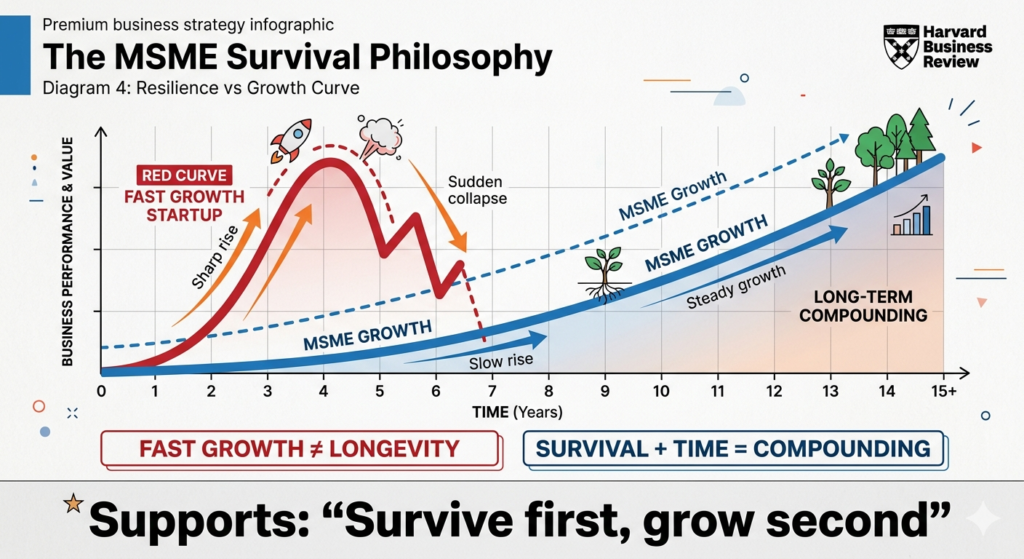
The startup world has spent the last decade celebrating a particular kind of ambition: move fast, scale aggressively, optimize for growth. There’s a logic to it, especially when capital is cheap and markets are expanding. But it produces organizations that are structurally brittle – companies that perform brilliantly in good conditions and fracture under unexpected stress.
The MSME philosophy, if I had to distill it into a single sentence, is this: survive first, grow second. It’s not pessimism. It’s sequencing. A business that is still operating in year twenty because it managed its risks carefully will ultimately create more value – more employment, more community stability, more compounding knowledge – than a business that scaled rapidly and collapsed in year five.
This ordering felt counterintuitive to me when I first encountered it. Now, after watching global supply chains seize up, watching well-funded companies fold during demand shocks, watching “efficient” organizations become fragile the moment their single key supplier hit trouble – I think the MSME instinct is simply more honest about how the world actually works. Redundancy is not waste. Optionality is not indecision. Maintaining a relationship that you might never need is not inefficiency – it’s a hedge. These businesses didn’t read about these ideas in a risk management textbook. They figured them out the hard way, through decades of exposure to environments where disruption is the default, not the exception.
What this means for Everyone Else
The uncomfortable question I want to leave with is not “how can MSMEs modernize?” That conversation has been happening for thirty years. The more interesting question is: what would it look like if larger organizations started learning from MSMEs?
I think it would look like companies taking relationship capital as seriously as financial capital. It would look like knowledge strategies that extend beyond the firm’s own walls. It would look like executives asking – before optimizing a process – whether that optimization makes them faster or makes them more fragile.
None of this requires abandoning analytical rigor or modern tools. AI will keep automating routine decisions and compressing information asymmetries. But it cannot replicate the trust built over fifteen years of honoring commitments. It cannot replace the instinct of an operator who has personally navigated four economic downturns and three supply disruptions. Those things are human, and they are slow to build.
The businesses in Ludhiana, Surat, Coimbatore, and thousands of other clusters across India have been building exactly those things – quietly, without consultants, without frameworks, and without much acknowledgment from the people who write about management for a living.
Maybe it’s time we started paying attention.