Five years ago, if someone had asked which company would sprint toward a $5 trillion valuation, most market watchers would not have predicted Nvidia. It was known in tech circles, respected in gaming, and appreciated by engineers-but it was not a household name in the way consumer giants are. Yet today, it sits at the center of one of the most dramatic wealth-creation stories in modern corporate history.
This article is not about artificial intelligence hype. It is not about speculative trading or short-term enthusiasm. It is about the mechanism that makes trillion-dollar outcomes possible. Because companies do not reach those heights by accident. They grow inside systems-systems that reinforce themselves over time.
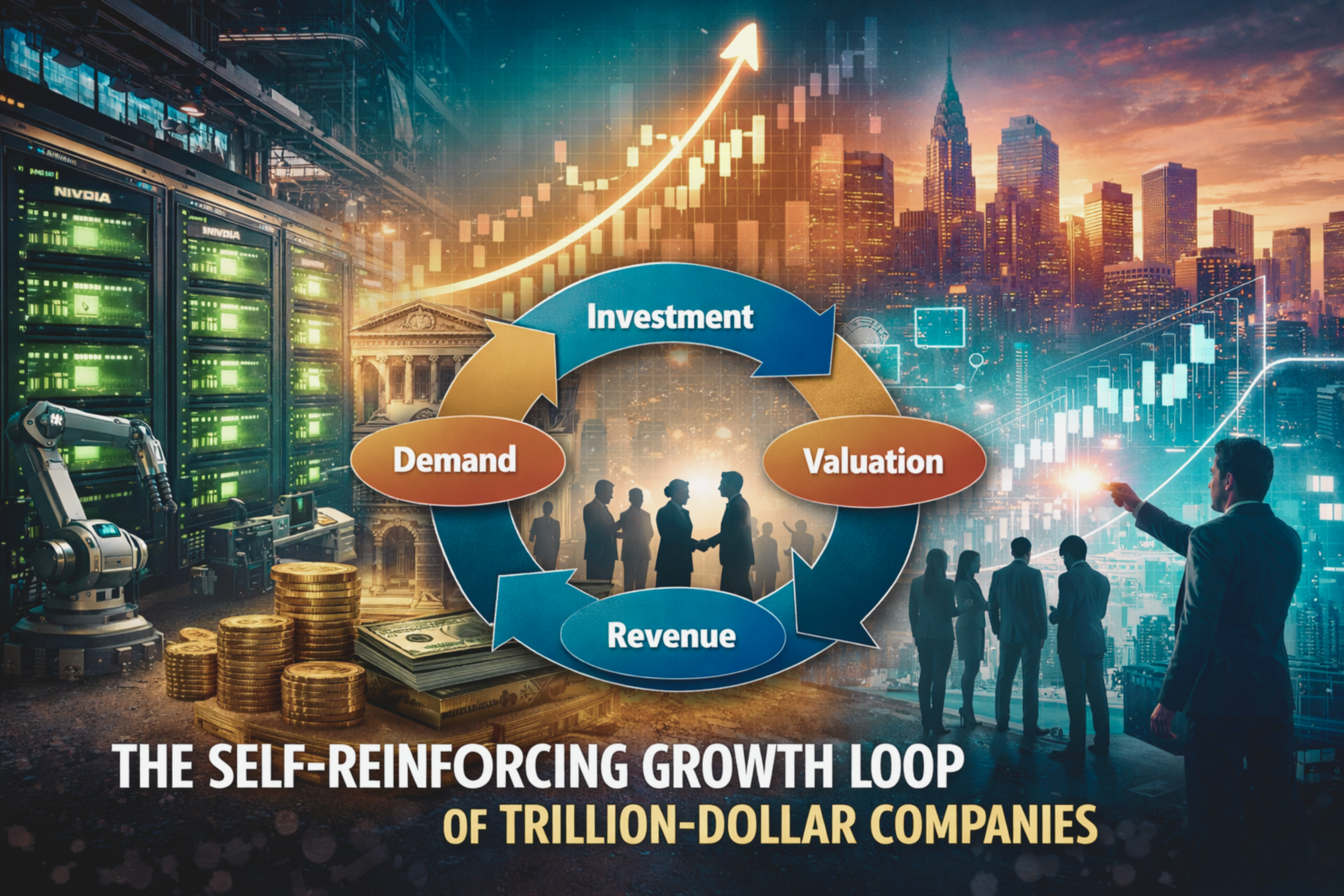
At scale, business stops behaving like a straight line and begins operating like a loop. Investment fuels demand. Demand fuels revenue. Revenue strengthens valuation. Valuation unlocks cheaper capital. That capital is then redeployed to fuel more investment. And the cycle repeats.
Understanding this loop is critical for anyone operating in the business world today. Whether you are building a startup, scaling a mid-sized company, or analyzing large corporations, this mechanism explains why certain firms accelerate while others plateau.
Let’s break this ecosystem down carefully.
The Shift from Selling Products to Building Ecosystem
Most people intuitively understand business in a linear way. A company builds a product. Customers buy it. Revenue is generated. Expenses are paid. Profit remains. End of story.
This model works at small scale. It describes how local businesses function and how individuals earn income. You work, you get paid, you spend, and the cycle restarts.
But once a company reaches strategic scale, the model changes.
At higher levels, companies can do more than sell products. They can influence the very market in which they operate. They can shape demand instead of merely responding to it. When that happens, the straight line transforms into a feedback loop.
The most powerful companies today do not just participate in markets-they architect ecosystems.
How Companies Create Their Own Demand
The core insight behind the trillion-dollar growth loop is deceptively simple: help your customers grow.
Imagine you manufacture a critical component used by fast-growing companies. The faster those companies expand, the more they need from you. Instead of passively hoping they succeed, you actively support their growth. You invest in their infrastructure. You provide financing. You form strategic partnerships. In some cases, you even take equity stakes.
Now your relationship changes. You are no longer just a supplier. You become a partner and enabler. Sometimes you become partially invested in the success of your buyers.
When your customers grow, they purchase more of your product. Their expansion directly strengthens your revenue. If you helped fund that expansion, your capital is now working in two places simultaneously: accelerating their growth and increasing your own sales.
This creates a reinforcing cycle. Each round of expansion strengthens both sides. Over time, the individual transactions blend into a broader ecosystem of interdependent growth.
How Ecosystem-Driven Growth Accelerates Revenue
When this pattern spreads across multiple companies, something powerful emerges: synchronized growth.
Suppliers scale alongside customers. Customers scale alongside infrastructure providers. Financial institutions align behind expanding sectors. Partnerships deepen. Long-term contracts replace short-term orders.
From the outside, the growth looks explosive. Revenues surge quarter after quarter. Market valuations climb rapidly. Observers assume it must be hype or coincidence.
But inside the system, the growth is coordinated. Companies are not growing randomly. They are strengthening each other.
When a business becomes central to an expanding network, its revenue becomes embedded in ongoing activity rather than isolated transactions. That embedded position makes future income appear more predictable. And predictability, in financial markets, is highly valuable.
Why Investors Value Future Potential Over Present Earnings
At early stages, companies are judged on current performance. Investors analyze margins, cash flow, and cost efficiency. But once a firm sits at the center of infrastructure, valuation shifts toward expectations of future dominance.
Markets begin asking different questions: How large could this business become if current momentum continues? How dependent are others on its products? How difficult would it be to replace?
Consistent revenue growth signals durable demand. Expanding partnerships signal structural positioning. Infrastructure build-outs signal long-term commitment.
As these signals strengthen, investor confidence rises. Confidence shapes perception. And perception shapes valuation.
Valuation, ultimately, is not just mathematics. It is a collective belief about future earning power.
How High Valuation Unlocks Cheaper Capital
Once valuation rises significantly, the company gains something more valuable than the number itself: access.
A higher market capitalization signals stability. Lenders perceive lower risk. Equity investors accept smaller ownership stakes in exchange for capital. Large institutions that previously hesitated now feel comfortable participating.
Capital becomes cheaper.
Lower interest rates reduce financing costs. Favorable equity terms minimize dilution. Strategic partners offer better agreements. Access to global capital markets improves.
When money becomes cheaper, expansion accelerates. The company can invest in research, build infrastructure, hire aggressively, and support partners-all without straining its balance sheet.
This is where the loop strengthens. Cheaper capital fuels more investment. Investment strengthens the ecosystem. The ecosystem drives more revenue. Revenue increases valuation. Valuation unlocks even cheaper capital.
The cycle feeds itself.
How AI Infrastructure Became a Revenue Multiplier
To understand this dynamic clearly, imagine a tool manufacturer that produces the best construction equipment in the world. Builders depend on these tools to construct houses.
Instead of merely selling tools, the manufacturer provides funding to selected builders so they can expand faster. With more capital, builders construct more houses. As they scale operations, they need additional tools. They return to the manufacturer to purchase larger quantities.
Sales surge. Investors notice the consistent growth. They conclude that the manufacturer sits at the center of a thriving ecosystem. Valuation rises.
With higher valuation, the manufacturer raises funds at better terms. It reinvests in more builders. The network expands further. The cycle continues.
This simplified example mirrors what happened in the AI infrastructure boom surrounding Nvidia. The company did not simply sell graphics processors. It became foundational to data centers, cloud providers, and AI startups. As those organizations scaled, their need for high-performance computing intensified. Revenue expanded rapidly. Markets responded.
From Private Investment Circles to Global Corporations
Although trillion-dollar valuations feel modern, the mechanism itself is not new.
For decades, wealthy investor networks operated through similar loops. Business leaders co-invested in ventures. They sat on each other’s boards. They financed deals together. They used assets as collateral across projects.
Capital circulated inside trusted circles. When one venture succeeded, valuations rose across the network. Borrowing became easier. New opportunities emerged. Success attracted more capital, which flowed back into the same ecosystem.
What has changed today is scale. Instead of small private circles managing millions, global corporations deploy billions across industries. The pattern remains the same, but the numbers are dramatically larger.
When Exponential Growth Feels Unreal
At extreme valuations, traditional financial intuition begins to struggle. Observers ask how one company can be worth more than entire sectors. They question whether growth justifies such massive numbers.
The confusion often arises because people instinctively think in linear terms. They assume revenue increases steadily and predictably. But feedback loops do not grow linearly. They compound.
When a company becomes embedded in infrastructure, each layer of growth supports the next. Expansion accelerates. Valuation responds to both present earnings and anticipated future dominance.
For a period of time, this can produce exponential outcomes. Eventually, growth slows-as it must in any finite system-but during the acceleration phase, the numbers appear almost surreal.
The Productive Side of the Loop
When aligned with real productivity, this mechanism can generate enormous societal value. Large infrastructure projects require upfront capital. Data centers, communication networks, energy grids, and advanced manufacturing facilities are expensive and complex.
Cheap capital and coordinated ecosystems accelerate their construction. Industries mature faster. Innovation spreads more rapidly. Costs decline over time due to scale efficiencies.
In this sense, the growth loop can be a powerful engine of progress.
The Structural Risks
However, the same loop can concentrate power. When capital becomes significantly cheaper for dominant firms, smaller competitors may struggle to access comparable resources. Market advantages compound.
If the ecosystem becomes too centralized, innovation can narrow rather than expand. Wealth disparities may widen. The reinforcing cycle benefits those already inside it.
Therefore, whether the loop produces broad prosperity or concentrated dominance depends on how inclusive and competitive the surrounding market remains.
Practical Lessons for Business Builders
For entrepreneurs and executives, the lesson is clear: think beyond transactions.
Ask how your company can embed itself within customer growth. Can you create partnerships that align incentives long-term? Can you provide tools, financing, or shared infrastructure that strengthens your clients’ expansion?
When your success becomes tied to your customers’ success, revenue stability improves. Predictability improves. Valuation improves.
Even at smaller scales, this principle applies. Service providers who invest in client outcomes often build deeper loyalty. Platforms that enable their users to earn more often grow faster themselves. Businesses that strengthen their ecosystem tend to outperform those operating in isolation.
Conclusion: Recognizing the Structure Behind the Scale
The rise of trillion-dollar companies is not mystical. It is structural.
Investment fuels demand. Demand fuels revenue. Revenue fuels valuation. Valuation unlocks cheaper capital. Cheaper capital fuels further investment.
Once the loop gains momentum, growth accelerates quickly. To outsiders, it looks sudden. In reality, it is the result of compounding relationships and strategic positioning.
Understanding this mechanism changes how you see modern business. It reveals why certain firms surge ahead and why scale advantages compound over time. More importantly, it offers insight into how smaller organizations can design their own reinforcing systems.
In the end, the true asset is not a product or even a valuation figure. It is the position within a growing ecosystem. Companies that learn to build and strengthen those systems are the ones that redefine what seems financially possible.